3.8(Q2)
CiteScore
27
h-index
Volume & Issue: Volume 6, Issue 3, Summer 2022, Pages 185-283 
Number of Articles: 7

Chemical profile of the essential oil from Chaerophyllum Khorossanicum czerniak. ex schischk of Iran

Pages 185-193

https://doi.org/10.22034/ajgc.2022.3.1

Majid Halimi Khalilabad, Ali Firoznia, Masomeh Taghavi, Mohabat Nadaf

Abstract The aim of this study is to determine the chemical composition of essential oils of Chaerophyllum khorassanicum belonging to the Apiaceae family for the first time. Identification of essential oils is necessary, for food, cosmetics- health industry, and medicinal uses. The plant was collected at the flowering stage of Khorassan Razavi Province in Iran, Farizi Village. The shoot parts of the specimen were dried in the laboratory and crushed to particles. The essential oils were obtained by hydro-distillation using Clevenger and analyzed by GC-MS. Fifty-one components were identified in Chaerophyllum khorassanicum essential oils which accounted for 97.2% of the essence. The major chemical category of the volatile compounds were the monoterpene hydrocarbons (65.5%), followed by oxygenated monoterpenes (24.5%). In particular, the main components were limonene 32.1%, methyl eugenol 16.2%, and β-Ocimene 15.6%. In conclusion, monoterpene hydrocarbons are characteristic and represent excellent chemotaxonomical markers for Chaerophyllum khorassanicum.
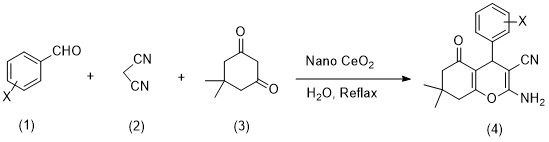
Aqueous media preparation of 2-amino-4H-benzopyran derivatives using cerium oxide nanoparticles as a recyclable catalyst

Pages 194-202

https://doi.org/10.22034/ajgc.2022.3.2

Bita Baghernejad, Seyedeh Mozhgan Hojjati Taromsari

Abstract 2-amino-4H-benzopyran derivatives have received considerable attention due to their valuable biological and medicinal properties such as anticoagulant, antispasmodic, diuretic, and anti-cancer activities. Benzopyran derivatives have strong relaxing activity on blood vessels, cardiac muscles, and smooth muscles. The present study reports the easy synthesis of 4H-benzopyran derivatives by using aldehyde, malononitrile, and dimedone in the presence of cerium(IV) oxide nanopowder as a non-toxic catalyst. The advantages of this method include catalyst recovery, high efficiency, short reaction time, and ease of operation method.

One pot synthesis of heterocyclic dihydroquinoline analogs incorporating quinoline and pyrimidine fused rings in condensation reaction using NCTDSS as a catalyst

Pages 203-222

https://doi.org/10.22034/ajgc.2022.3.3

Saghar Mowlazadeh Haghighi, Azar Purkhosrow, Ali Khalafi-Nezhad, Somayeh Oftadehgan

Abstract The synthesis of dihydroquinoline derivatives is very important for the pharmaceutical industry due to its many biological activities. In our ongoing efforts to promote new synthetic strategies for preparing heterocyclic compounds in this study, we performed reflux reactions with the nanocrystalline-TiO2 on dodecyl-sulfated silica support (NCTDSS) catalyst by using a one-pot method. Finally, high-yield products were synthesized and characterized by using different techniques such as FT-IR, 1H NMR, and 13C NMR. This procedure has several privileges including simple operation, economy, safe environment, short reaction time, and high-yield.

Quinolone antibiotics and their applications in metal complexes: An update

Pages 223-247

https://doi.org/10.22034/ajgc.2022.3.4

Aseel H. Abad Al-Ameer

Abstract Antibiotics called quinolones have a wide range of action, good oral absorption, and good bioavailability. Quinolones are capable of binding metallic ions and form complexes where they would operate as bidding, unidentating, and bridging ligands because of the chemical features within their nucleus, which include an O2 atom in the carbonyl group at place 4, a basic piperazinyl ring at site 7, and a carboxylic acid job at position 3. Quinolones hold onto the metal ions to form complexes that could function as bidentates, unidentates, or bridging ligands. Polymeric complexes in a solid state can be coordinated in various ways. Under extremely when exposed to acidic circumstances, quinolone molecules with a base end nucleus protonate and show up as cations in ionic complexes. The pharmacokinetics bioavailability and mode of action of these bactericidal drugs are all impacted by interactions with metal ions, which also have an impact on the solubility, pharmacokinetics, and bioavailability of quinolones. Many metal complexes were revealed to have antibacterial activity equivalent to or greater than the parent quinolones. Novel anticancer medications have come from the novel techniques for the formation of metal complexes of quinolones. The two primary areas of analytical applications of complex formation with metallic ions are metal I detection depending on complexation with quinolones and quinolone determination based on formation of complexes with metal ions.

Transformation of aryl aldehydes to alcohols by solvent-less ‎crossed cannizaro reaction

Pages 248-254

https://doi.org/10.22034/ajgc.2022.3.5

Othman O. Dakhil, Mohamed Gebriel Elarfi, Hussniyia A. Al-Difar

Abstract A crossover Cannizaro reaction by using traditional and grinding techniques was used to convert aryl aldehydes into aryl alcohols. The condensation of several substituted aryl aldehydes with formaldehydes in the presence of potassium hydroxide permitted the aryl alcohols to be produced in a high yield without the use of any solvent. Elemental analysis, FT-IR, and 1H-NMR spectra were used to characterize the final products.

Analysis and detection of incident light attenuation with a continuous flow injection by using the precipitating reaction of fluconazole and phosphomolybidic acid by NAG4SX3-3D instrument

Pages 255-272

https://doi.org/10.22034/ajgc.2022.3.6

Nagham Shakir Turkie, Sarah Faris Hameed

Abstract A quick and sensitive approach for detecting fluconazole by formation a pale yellow precipitate from the interaction of phosphomolybdic acid and fluconazole in a sulfuric acid medium. The relevant parameter was investigated to increase the sensitivity of the newly proposed technique. L.O.D. = 16.0792 ng/sample at the lowest concentration on the calibration curve over the progressive dilution exhibited, a linear range (0.01-6) mmol.L-1 for fluconazole measurement, significantly lower than 0.2 RSD% for repetition (n = 6). With a linear R2 of 99.73% and a linear dynamic range of 0.9987, (correlation coefficient). The UV-spectrophotometric at λmax = 260 nm and the turbidimetric method were used as benchmarks against which to evaluate the performance of the suggested strategy. It was determined that, in comparison to the conventional method by using 10 mm irradiation, the sensitivity of the created technique, its usage of few chemicals, and its dynamic mechanism for preventing precipitated particle setting during tests all set it apart. The continual dilution of CFIA also allows for the manipulation of either high or low concentrations, thereby increasing the range of conceivable uses. Compared with the reference procedures, the developed method is thought to be the most accurate means of identifying fluconazole molecules in their purest and the most pharmaceutically effective forms.

Green synthesis of nanocellulose fibers from ragi stalk and its characterization

Pages 273-283

https://doi.org/10.22034/ajgc.2022.3.7

Prasanna Kumar Jammapura Kallappaa, Prakash Gowdra Kalleshappa, Suresh Basavarajappa, Basavarajappa Bachi Eshwarappa

Abstract Nanocellulose derived from natural substances offers a plethora of opportunities to produce superior material properties for various applications. In the present study, nanocellulose was extracted from Ragi Stalk (Eleusine Coracana) an abundantly available agricultural biomass. The cellulose was alkali-treated followed by bleaching to remove hemicellulose, Pectins, wax, and lignin. Green solvent i.e. ionic liquid (1-butyl-3-methylimidazolium chloride ([Bmim]Cl)) was used to synthesize the nanocellulose through sonication and centrifugation. The FT-IR spectra reveal the functional groups and substantial conversion of cellulose to nanocellulose. The crystallinity of synthesized nanocellulose is illustrated by XRD. The surface architecture and the obtained nanocellulose size are represented by SEM and TEM monographs. The new finding is that the TEM images show the synthesized nanocellulose fibres have a smaller dimension between 14.58 and 22.17 nm evidenced through sonication. The thermal stability of the obtained nanocellulose was evidenced by using TGA/DTA. The thermal studies record that synthesized nanocellulose fibres shows phenomenal thermal stability up to 460 °C.