3.8(Q2)
CiteScore
27
h-index
Volume & Issue: Volume 1, Issue 1, Summer 2017, Pages 1-55 
Number of Articles: 6

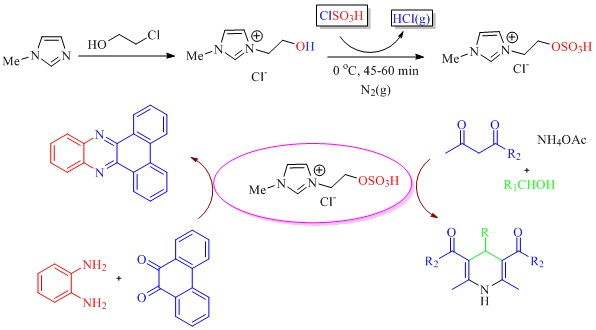
Synthesis of dihydropyridines and quinoxaline derivatives using 1-methyl-3-(2-(sulfooxy)ethyl)-1H-imidazol-3-ium chloride as a new, reusable and efficient Bronsted acidic ionic liquid catalyst

Pages 1-15

https://doi.org/10.22631/ajgc.2017.46496

Sami Sajjadifar, Sarvin Mohammadi-Aghdam

Abstract In this work, the efficiency, generality and applicability of new silica supported Brønsted acidic ionic liquid (BAIL) 1-methyl-3-(2-(sulfooxy)ethyl)-1H-imidazol-3-ium chloride as heterogeneous and green catalyst for organic transformations are studied. Herein, the following one-pot multi-component reactions in the presence of [Msei]Cl are investigated: (i) the synthesis of quinoxaline derivatives from phenylendiamine and 1,2-diketones in EtOH and under mild conditions (room temperature), (ii) the preparation of 1,4-dihydropyridines from one-pot multi component condensation of 1,3-dicarbonyl compounds(2 equiv.), NH4OAc (1.5 equiv.) and aldehydes (1 equiv.) under solvent-free conditions at moderate temperature (90 °C). High yields, relatively short reaction times, efficiency, generality, clean process, simple methodology, low cost, easy work-up, ease of preparation and regeneration of the catalyst and green conditions (in the synthesis of the quinoxaline derivatives) are advantages of the application of [Mesi]Cl as catalyst in the above organic reactions.

Production of biodiesel from jatropha curcas oil using solid heterogeneous acid catalyst

Pages 16-23

https://doi.org/10.22631/ajgc.2017.46511

Hadi Jabbari, Nader Noroozi Pesyan

Abstract Biodiesel produced by the transesterification of vegetable oils is a promising alternative fuel to diesel because of limited fossil fuel resources and environmental concerns. The use of heterogeneous catalysts greatly simplifies the technological process by facilitating the separation of the post-reaction mixture. The use of heterogeneous catalysts greatly simplifies the technological process by facilitating the separation of the post-reaction mixture. The purpose of the present work was to examine a heterogeneous catalyst, in particular, to produce methyl esters of jatropha curcas oil (JCO). In this study, the trans esterification of JCO with methanol was studied in a heterogeneous system, using Mg-Al hydrotalcites as solid base catalysts. The dependence of the conversion of JCO on the reactions variables such as the molar ratio of methanol/ oil, the amount of catalysts used, reaction temperatures and reaction times were performed. The conversion of 99% was achieved under the optimum reaction conditions.

2,6-Pyridinedicarboxylic acid as an efficient and mild organocatalyst for the one-pot synthesis of xanthene derivative

Pages 24-33

https://doi.org/10.22631/ajgc.2017.92575.1005

Sobhan Rezayati, Ehsan Mirzajanzadeh, Hamed Seifournia

Abstract Simple and efficient protocols have been developed for the one-pot synthesis of aryl-14H-dibenzo[a,j]xanthenes and 1,8-dioxo-octahydroxanthenes. (i) A cost-effective, simple and convenient procedure for the synthesis of aryl-14H-dibenzo[a,j]xanthenes has been developed via a one-pot condensation from substituted benzaldehydes (1 equiv) and βnaphthol (2 equiv) in the presence of 2,6-pyridinedicarboxylic acid (2,6PDCA) under solvent-free conditions. (ii) The one-pot condensation of substituted benzaldehydes (1 equiv) and 5,5-dimethyl-1,3cyclohexanedione (dimedone) (2 equiv) in the presence of 2,6pyridinedicarboxylic acid (2,6-PDCA) under solvent-free conditions leads to 1,8-dioxo-octahydro-xanthenes. In these  protocols several advantages such as: excellent yields, very short reaction times, easy work-up, simple methodology are offered.

Microwave-assisted multicomponent reaction for the synthesis of 2-amino-4H-chromene derivatives using ilmenite (FeTiO₃) as a magnetic catalyst under solvent-free conditions

Pages 34-40

https://doi.org/10.22631/ajgc.2017.93142.1006

Saeid Taghavi Fardood, Ali Ramazani, Pegah Azimzadeh Asiabi, Yousef Bigdeli Fard, Behrooz Ebadzadeha

Abstract A green and highly efficient method has been developed for the synthesis of 2-amino-4H-chromene derivatives in the presence of FeTiO3 as magnetic catalyst via one-pot three-component condensation reaction of aromatic aldehydes, malononitrile and α- or β-naphthol without solvent under microwave irradiation. Mild reaction conditions, short reaction times, simple work-up, use of an economically convenient catalyst, and excellent product yields are the advantageous features of this method. The catalyst can be easily recovered by a simple magnetic separation and can be recycled six times with no significant loss of catalytic activity.

Synthesis of polyol esters by p-toluenesulfonic acid catalyst as synthetic lubricant oils

Pages 41-45

https://doi.org/10.22631/ajgc.2017.89392.1002

Hadi jabbari, Nader Noroozi Pesyan

Abstract A most effective and less energy demanding method of producing fatty esters, polyol esters, by esterifying fatty acids, with a pentaerythritol and trimethylolpropan alcohols in the presence of an acid catalyst at elevated temperature wherein an azeotroping agent, particularly toluene, is used to facilitate continuous removal of water by distillation, formed as a by-product during the esterification reaction. The esterification reaction is completed within 5 hours, pentaerythritol and trimethylolpropan esters were produced. 

H-mordenite zeolite as an efficient, rapid and recyclable catalyst for chemoselective synthesis of 1,1-diacetates under solvent-free conditions

Pages 46-55

https://doi.org/10.22631/ajgc.2017.92530.1003

Sami Ullah Bhat, Rawoof Ahmad Naikoo, Rayees Ahmad Bhat, Manzoor Ahmad Malla, Radha Tomar, Neeraj Kumar Gatum, Kautilya Rao Tiwari

Abstract In this investigation H-mordenite zeolite has been shown to be an efficient, rapid, green, stable, chemoselective and recyclable catalyst for the synthesis of 1,1-diacetates (acylals) of various aromatic aldehydes under solvent-free conditions at room temperature. The main advantages of this protocol include low catalyst loading, shorter reaction time, excellent yields, ecofriendly, mild-condition, easy work-up procedures and reusable catalyst. This method must be useful in future for the synthesis of similar derivatives. The synthesized zeolite was characterized by various techniques via X-ray diffraction (XRD), scanning electronic microscopy (SEM), fourier transform-infrared (FTIR spectroscopy) and brunauer–emmett–teller (BET) surface area analysis. The synthesized reaction products were characterized by FTIR and 1H NMR technique. Further investigation of the application of H-MOR zeolite for other reactions is ongoing in our laboratory.