3.8(Q2)
CiteScore
27
h-index
Volume & Issue: Volume 8, Issue 3, May and June 2024, Pages 217-359 
Number of Articles: 10

Burning or Burying Waste Increases the Risk of Cancer, Epidemics, and Environmental Issues Affecting the Atmosphere, Land, and Water

Pages 217-233

https://doi.org/10.48309/ajgc.2024.420730.1453

Salma Korbag, Issa Korbag

Abstract The growing population of Libya poses a significant environmental threat due to waste management challenges, including household, military, medical, electronic, hazardous metal landfills, heavy metal pollution, and methane emissions contributing to global warming. Waste management in Libya is poor, with incineration and landfilling leading to various diseases as cancer, respiratory, dermatological, and gastrointestinal ailments. Online surveys show a high rate of incineration (68%), followed by 23% landfilling, and while recycling rates are low or non-existent, with only 2%. Toxic metals can harm organs, water, soil, and air particles, necessitating waste management education and legislation on hazardous chemicals.
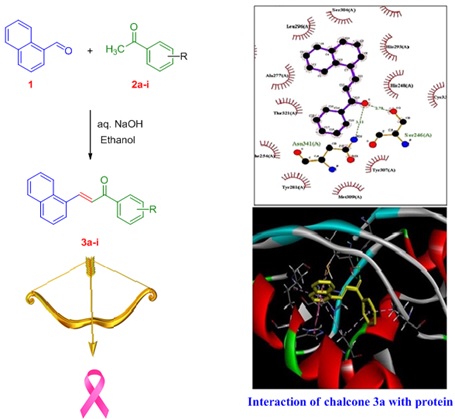
Synthesis, Molecular Docking, and Biological Evaluation of Some New Naphthalene-Chalcone Derivatives as Potential Anticancer Agent on MCF-7 Cell Line by MTT Assay

Pages 234-246

https://doi.org/10.48309/ajgc.2024.418444.1458

Vijaykumar S. More, Sharad P. Panchgalle, Ranjit A. Gayake, Vasant B. Jagrut, Manisha M. Kodape, Deekshaputra R. Birhade, Mahendra N. N. Lokhande

Abstract Naphthalene chalcones (3a-i) with excellent yields were achieved through the use of aromatic ketones, 1-naphthaldehyde, and aqueous NaOH in the synthesis process. The synthesized chalcones were bio-evaluated as potential tubulin polymerization inhibitors for the treatment of breast cancer. The antiproliferative potential of each synthesized compound against the MCF-7 cell line was assessed. The majority of the compounds showed strong antiproliferative properties. With an IC50 value of 222.72 µg/mL, compound 3f exhibited the most antiproliferative activity among them, surpassing that of 5FU (IC50, 51.47 µg/mL).

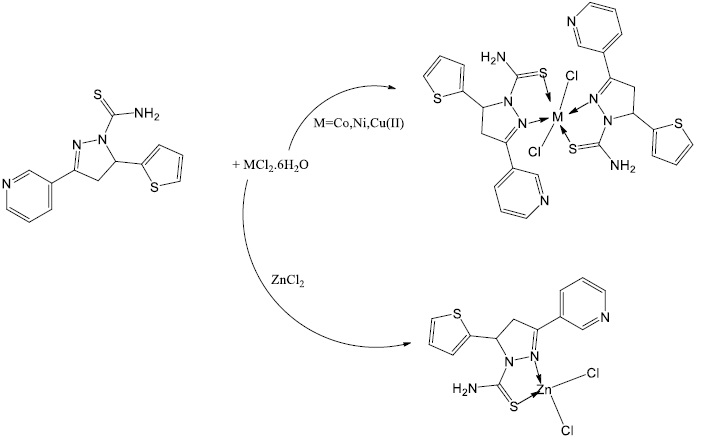
Review on Preparation, Coordination and Clinical Chemistry of 2-Pyrazoline Derivatives: Synthesis and Characterization of 5-(thiophen-2-yl)-3-(pyridin-3-yl)-4,5-Dihydro-1H-Pyrazole-1-Carbothioamide and their Co(II), Ni(II), Cu(II) and Zn(II) Complexes

Pages 247-260

https://doi.org/10.48309/ajgc.2024.422945.1456

Mahmoud Najim Abid Al-Jibouri, Mohammed A.K.Al-Souz, Taghreed M.Musa

Abstract The N-substituted 2-pyrazoline derivative has received significant encouragement from researchers for their effective roles in wide range of biological activities and has been used as catalysts and colorimetric reagents in the determination of trace heavy metals. This review article focuses on the pyrazolines routes, such as the preparation of pyrazole derivatives via chalcones. It also demonstrates that 2-pyrazoline complexes were biologically active and have had a range of clinical applications. The recent review collects the significances of 2-pyrazoline ligands and main methods of preparation and their role in the field of coordination chemistry. The observed data from update literature investigates the well-known method of Micheal addition of hydrazine or thiosemicarbazide derivatives to the ά-β-unsaturated carbonyl compounds. Furthermore, the chelation ability for most prepared 2-pyrazoline ligands have confirmed the active sites of immine moiety of pyrazole ring beside the sulfur atom forming five-membered ring with the studied d-metals. Likewise, the recent work involves the synthesis of new ligand of 2-pyrazoline from condensation chalcone with 4-thiosemicarbazide in alkaline medium. The new prepared ligand5-(4-thiophen-2-yl)-3-(pyridin-3-yl)-4,5-dihydro-1H-pyrazole-1-carbothioamide and its metal complexes with cobalt(II), nickel(II), copper(II), and zinc(II) were fully characterized with the elemental micro-analyses (C.H.N.S), determination of metal content, FT-IR, and UV-Visible spectra. Furthermore, the magnetic susceptibility of solid metal complexes and molar conductivity measurements of their solutions in DMSO solvent have confirmed their chemical structures. The observed data from analytical methods revealed the octahedral geometry in 2:1 mole ratio (L:M) except the tetrahedral structure in [ZnLC]Cl formula. The diamagnetic complex of nickel(II) was approved as square planner geometry with high value of molar conductance.

Graphene Oxide Modified with Tetramethylethylenediamine Ammonium Salt as a Powerful Catalyst for Production of Trisubstituted Imidazoles

Pages 261-277

https://doi.org/10.48309/ajgc.2024.430848.1469

Safie Mehrizi Marvast, Esmael Rostami

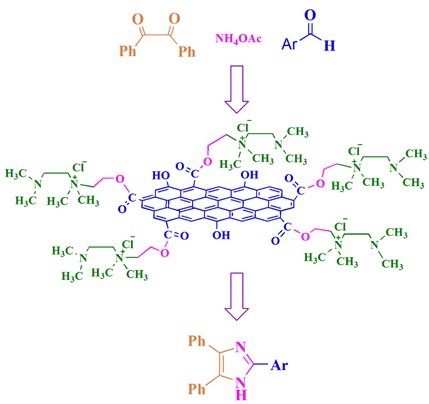
Abstract A new and efficient graphene oxide catalyst was synthesized in this study to prepare trisubstituted imidazoles. Graphene oxide was first modified with 2-chloroethanol, and then treated with N,N,N,N-tetramethylethylenediamine. After that, the obtained catalyst was characterized by XRD, FTIR, FESEM, EDAX, and TGA. The reported catalyst was utilized for the synthesis of trisubstituted imidazoles from benzil, aldehydes, and ammonium acetate. Reaction efficiently proceeded via a one-pot multicomponent route under solvent-free conditions. Catalyst offered some advantages over reported ones such as sustainability, cost-effectiveness, ease of handling, storage, and recovery, in addition to non-metal structure. The reported procedure has a series of benefits, including medium conditions, high yields, no by-products, short reaction times, and easy work-up. Reported catalyst can be used in chemistry, material sciences, and related disciplines for diverse applications.

Extraction of Cellulose from Bagasse for the Synthesis of Alginate: Cellulose Porous Beads

Pages 278-295

https://doi.org/10.48309/ajgc.2024.440660.1475

Eny Yulianti, Lilik Miftahul Khoiroh, Rif’atul Mahmudah, Sindi Puspitasari, Faiqotul Himmah, Tzu-Teng Huang, Imtiaz Ali Laghari, Ahmad Zikri, Mohammad Abdullah, Rahadian Zainul, Tarek A. Elkhooly

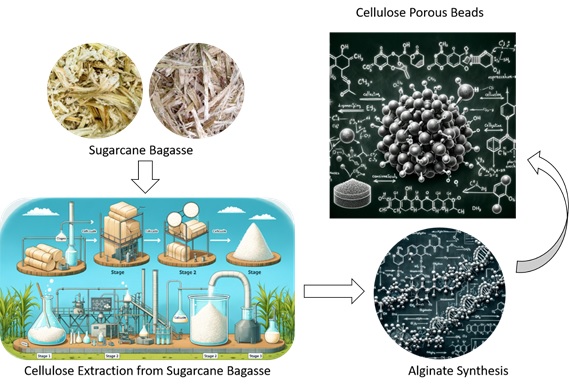
Abstract This study aimed to develop the production of porous cellulose beads from bagasse. Alkali extraction with 6% sodium hydroxide was identified as the optimal solvent for cellulose, based on the swelling ratio. This process resulted in viscose cellulose solution with improved characteristics, including a density of 1.099 g/ml, viscosity of 0.024 Pa·s, molecular weight of 171.668 g/mol, and a swelling ratio of 50.8%. The beads fabrication using the cellulose extract combined with alginate led to the formation of beads with a homogeneous and rough surface. Calcium carbonate (CaCO3) was utilized as a porogen and zinc acetate served as the crosslinking agent. The optimal composition of alginate to cellulose xanthate for bead formation, determined through evaluations of bead geometry, swelling power, and surface porosity using SEM-EDX, was found to be a 2:2 ratio.

A Green Surface Prepared with Highly Applicable of Advanced Oxidative Processes AOPs for Removal of Riboflavin Drug Pollutant Remediation

Pages 296-307

https://doi.org/10.48309/ajgc.2024.444917.1479

Rathab Ali Ahmed, Ola Hamad Salah, Haider Falih Shamikh Al-Saedi, Manal Morad Karim, Shahad Abdulhadi Khuder, Anaheed Hussein Kareem, Fathi Jihad Hammady

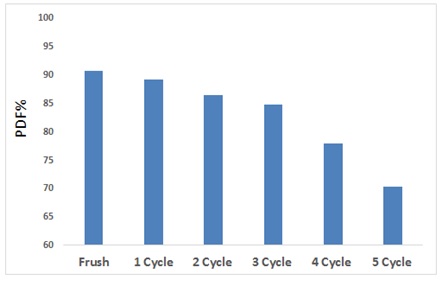
Abstract In this study, the prepared, characterization, and photo-catalytic performance of zinc oxide/activated carbon (ZnO/AC) nanocomposites prepared via hydrothermal process to be applied for advanced oxidative process (AOPs). The ZnO/AC nanocomposites was characterized via field emission scanning electron microscopes (FE-SEM), transmission electron microscopy (TEM) and energy dispersive X-ray analysis (EDX) analyses. Different parameters were utilized to achieve best conditions including, weight of nanocomposite, and concentration of Riboflavin drug. Likewise, the photo-degradation appear high efficiency and activity when reused 5 cycles and confirm results that this photo-catalyst has promising prospects and a high ability to remove pollution from aqueous solution. Furthermore, AC can be a realistic and affordable re-placement for pricey noble metals. Photocatalytic activities of the catalytic adsorbents are used as model pollutant (Riboflavin drug) under UV irradiation. ZnO/AC nanocomposites showed excellent photo-catalytic activity (~99% degradation of drug in 60 min) compared with that of bare ZnO NPs and AC. In addition, a recycle or reused experiment demonstrated the best stability of the nanocomposite; the ratio photo-degradation of ZnO/AC reached last more 70% after five cycle successive runs and possessed strong photo-catalytic ability. The improve photo-catalytic activities may be related to the effects of the relatively high surface area. The best data between the studied photo-catalysts appear the drug removal efficiency of ∼92% in 1 h under UV light irradiation.

Improved Photocatalytic Degradation of Pharmaceutical Compounds from Aqueous Solutions Using Pd/Zno Nanocomposite as a Model of Environmental Applications

Pages 308-318

https://doi.org/10.48309/ajgc.2024.449143.1487

Rathab Ali Ahmed, Ola Hamad Salah, Russul Reidh Abass, Manal Morad Karim, Shahad Abdulhadi Khuder, Salam Ahjel, Imad Ibrahim Dawood

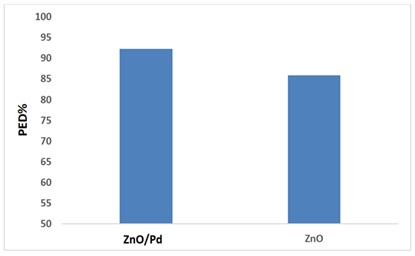
Abstract Heterogeneous photocatalysts have been widely utilized for the degradation of pharmaceuticals in wastewater. Under UV light irradiation, photocatalysis of the Sulfadiazine Hydrochloride (SFD) drug in wastewater using Pd/ZnO nanocomposite was studied. The nanocomposite was prepared using a hydrothermal process. The incorporation of Pd nanoparticles into the ZnO nanostructure increased the porosity and surface area, as well as the number of functional and active sites of the nanocomposite, which can improve the photocatalytic process of drug removal. According to structural analyses using TEM and SEM, Pd/ZnO refers to a highly stable and architectural morphology. The photocatalytic degradation process revealed that after 60 min, it led to the removal of the SFD drug, and a degradation efficiency of up to 85.77% was obtained using ZnO NPs, while the complete Pd/ZnO nanocomposite photocatalytic process was obtained after 60 min, with a degradation efficiency of up to 92.25%. The high effectiveness of the prepared surface of the Pd/ZnO nanocomposite on the degradation of SFD drugs from aqueous solutions was confirmed, and the results showed the effective performance of the prepared photocatalyst in the removal of drugs. Likewise, reuse and regeneration have an important role to play in reducing the economic cost and secondary pollution, as the Pd/ZnO nanocomposite has a good ability to regenerate compared to zinc oxide, with a high percentage (92.25% to 82.87%) of four cycles.

Development of an Integrated Air Quality Monitoring System for Temperature, Humidity, CO, and PM10 Measurement

Pages 319-335

https://doi.org/10.48309/ajgc.2024.445430.1481

Ambran Hartono, Dhoni Ikhsan Widodo, Salsabila Tahta Hirani Putri, Rahadian Zainul, Mohammad Abdullah, Ahmad Zikri, Imtiaz Ali Laghari

Abstract This study addresses the growing need for cost-effective and straightforward air quality monitoring solutions. We present the development and testing of an integrated sensor system combining DHT11, MQ-7, and GP2Y1010AU0F sensors for measuring temperature, humidity, CO gas, and PM10 levels. Our calibration tests demonstrate a sensor accuracy exceeding 96%, with individual accuracy rates for temperature, humidity, CO, and PM10 sensors at 98.42%, 96.81%, 96.95%, and 97.75%, respectively. These findings underscore the potential of our integrated sensor design in providing reliable and affordable air quality monitoring for community use.

Tetracycline Drug Degradation Using Binary Hybrid Advanced Oxidation Processes of Photocatalytic (UV/ TiO2 and UV/ZnO) in Aqueous Solutions

Pages 336-348

https://doi.org/10.48309/ajgc.2024.449148.1488

Haider Falih Shamikh Al-Saedi, Ola Hamad Salah, Russul Reidh Abass, Manal Morad Karim, Salima B. Alsaadi, Salam Ahjel, Zainab Jamal Hamoodah, Rathab Ali Ahmed

Abstract In this study, we examined the capacity of photocatalytic degradation catalyzed by TiO2 NPs and ZnO NPs to remove the tetracycline TC drug in different solution pHs (3–10). TiO2 NPs and ZnO NPs powders were prepared using the hydrothermal method and characterized via FESEM, TEM, TGA, and XRD. The effects of several method factors, such as weight of photocatalyst (0.1-0.4 g), concentration of TC drug (25-100 mg/L), different pH values (3-10), and irradiation time, on the removal of TC drug were studied. The photocatalytic degradation capacity of TC drug was fast in the present optimum condition (pH 10) and slower in (pH 3) of TiO2 NPs and ZnO NPs; the degradation capacity of the TC drug under UV light decreased with an increasing concentration of TC drug. The photocatalytic degradation capacity of TiO2 NPs is 81.33%, while the photocatalytic degradation capacity of ZnO NPs is 92.45 %. These data underline the use of effective, eco-friendly, easily available, and low-cost TiO2 NPs and ZnO NPs as photocatalysts for degrading TC drugs in aqueous solutions. Therefore, as shown by the results, the photocatalytic degradation of the TC drug using zinc oxide nanoparticles is greater than that using TiO2 nanoparticles.

Grass Waste: A Highly Biosorbent for the Removal of Malachite Green Dye From Aqueous Solution

Pages 349-359

https://doi.org/10.48309/ajgc.2024.449167.1489

Turki Meften Saad, Ola Hamad Salah, Talib Kh. Hussein, Salam Ahjel, Russul Reidh Abass, Zahraa Hamzaa Abud Alzahraa, Nafaa Farhan Muften, Alaa A. Omran

Abstract Grass waste (GW), a low-cost agricultural waste, is a more effective adsorbent to remove malachite green MG dye. Treatments physical or chemical of GW by soaking in solution H2O2 (10%) for 4 hours at 25 °C. The removal of MG from bio-sorption GW was studied at several weights of GW (0.01–0.1 g), equilibrium time (2–120 min), initial concentration (10–100 mg/L), and pH solution (2–10). The effect of the factors on the adsorption efficiency was studied using the batch process. Increasing MG dye concentration, the adsorption efficiency of GW increased, but the removal percentage decreased from 10.599 mg/g to 110.99 mg/g to 94.11% to 83.08%. The data evidently displayed a removal percentage of MG of about 89.89% at a weight of GW of 0.08 g/100 mL. The adsorbent was characterized via SEM and TEM. Desorption of MG dye studies was performed with hydrochloric acid, sodium hydroxide, phosphoric acid, acidic acid, and H2O. A high removal percentage of 89.088% in acid medium 0.1 N hydrochloric acid. With the addition of HCl, the solution pH decreases, and hence, at a pH of 3, the GW surface becomes large and protonated, and the attachment among the molecules of dye and GW becomes weakened. The data revealed that bio-sorption GW adsorbent is potentially a very low-cost and eco-friendly adsorbent for the removal of MG dye.