3.8(Q2)
CiteScore
27
h-index
Volume & Issue: Volume 7, Issue 1, Winter 2023, Pages 1-69 
Number of Articles: 7

ZnO Nanoparticles: A Highly Efficient and Recyclable Catalyst for Tandem Knoevenagel-Michael-Cyclocondensation Reaction

Pages 1-8

https://doi.org/10.22034/ajgc.2023.1.1

Raed Muslim Mhaibes, Zeinab Arzehgar, Mohammad Mirzaei Heydari, Leila Fatolahi

Abstract In this study, Zinc oxide (ZnO) nanoparticles have been synthesized as a new recyclable solid acid catalyst. Techniques such as FE-SEM, TEM, and XRD were used to characterize as prepared nanocatalyst. Then, the catalyst was used for one-pot three components synthesis of Tandem Knoevenagel-Michael-Cyclocondensation Reaction from various aldehydes, dimedone, and malononitrile in ethanol under reflux conditions. The attractive features of this process are easy work-up, reusability of the catalyst, excellent yields, short reaction times, and mild reaction conditions.

Phytofabrication, and Characterization of Ag/Fe3O4 Nanocomposite from Rosa Canina Plant Extracts Using a Green Method

Pages 9-16

https://doi.org/10.22034/ajgc.2023.1.2

Nasrin Pourbahar, Somayeh Sattari Alamdar

Abstract In this study, the Ag/Fe3O4 nanocomposite was prepared by Rosa Canina fruit extract as a suitable reducing source and stabilizing agent. The green synthesized nanostructure was characterized using UV–visible, X-ray diffraction analysis (XRD), field emission scanning electron microscope (FE-SEM), energy-dispersive X-ray spectroscopy (EDX), Fourier-transform infrared spectroscopy (FT-IR), and vibrating-sample magnetometer (VSM) techniques. TEM analysis of Ag/Fe3O4 nanocomposite showed a spherical shape (MNPs) with an average size of 8–28 nm.

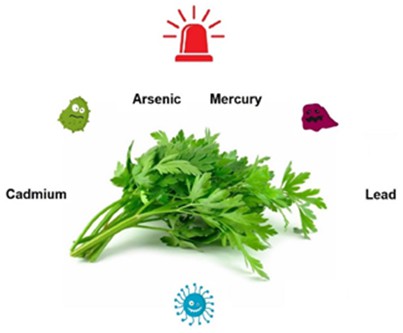
Evaluation of Microbial Contamination and Toxic Metals Content of Parsley (Petroselinum Crispum) Obtained in Kuh Boneh Region (Lahijan City, North of Iran)

Pages 17-24

https://doi.org/10.22034/ajgc.2023.1.3

Pegah Ghiasvandnia, Milad Sheydaei, Milad Edraki

Abstract In this study, microbial contamination included the total microbial count and coliform, as well as the content of toxic metals such as arsenic (As), cadmium (Cd), lead (Pb), and mercury (Hg) in parsley (petroselinum crispum) prepared from local farms in Kuh Boneh Region (Lahijan City, north of Iran) was investigated. The content of toxic metals was evaluated by flame atomic absorption spectrophotometer, and the results showed that content of these metals is lower than the standard level. However, the results of microbial investigation revealed that the samples are contaminated. In fact, the number of colonies was very high and according to the standards, these samples are harmful to health.

Polymerization of Graphite and Carbon Compounds by Aldol Condensation as Anti-Corrosion Coating

Pages 25-38

https://doi.org/10.22034/ajgc.2023.1.4

Fatemeh Banifatemeh

Abstract In this article, a simple method was applied to polymerize carbon base compounds such as graphite, graphite oxide, carbon active, and cellulose. The polymerization was based on self-aldol condensation of acetone in acid media. Acid-modified carbon compounds act as a substrate to initiate the condensation reaction. This reaction is influenced by the time of condensation, temperature, and acetone:acid ratio. Their equal ratio causes crystallization of carbon compounds. The polymer is obtained by increasing the ratio. Photographs and results obtained from Fourier transform infrared (FT-IR), X-ray diffraction (XRD), scanning electron microscope (SEM), energy dispersive X-ray (EDX) analysis, and thermal analysis shows the differences that have appeared due to polymerization. The intensity of 2967 cm-1 peak in FT-IR spectra that is attributed to C-H bonds with sp3 hybridization significantly increased after the polymerization of graphite and carbon active. The thermal analysis shows the gradual weight loss for polymers as the polymer loses the monomer one by one. These polymers, similar to bitumen, are sticky and non-conductive as can be seen in the Tafel diagram. The corrosion resistance of metal coated with graphite polymer using weightless measurements, showed that these polymers could be used as an anti-corrosion coating.

Silica-Imidazole Solid Catalyst for N-Glycine Derivatives Synthesis

Pages 39-46

https://doi.org/10.22034/ajgc.2023.1.5

Kasim Mohammed Hello, Nahla Ghaze Fahad

Abstract Schiff base was reacted with α-chloroacetic acid to produce N-(α-chlorobenzyl)-N-phenylglycine derivatives (N-Gly) over solid heterogeneous catalyst. Different N-Gly derivatives were synthesized over the catalyst with approximately 90% yield. Both calculated and theoretical elemental analyses of N-Gly derivatives were in agreement with each other. The functional groups of N-Gly derivatives were proved by the FT-IR spectroscopy. The melting points N-Gly derivatives were matched with those in the literature. The catalyst was produced by immobilizing sodium silicate from rice husk with 3–(chloropropyl)triethoxysilane followed by refluxed the product with p-xylyl-di-imidazolium chloride. The results showed that the optimum catalyst conditions were 5 h as reaction time, 0.25 g mass of catalyst, 90 °C as reaction temperature, and toluene as the best solvent.

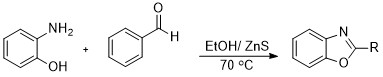
Zinc Sulfide (ZnS) Nanoparticles: An Effective Catalyst for Synthesis of Benzoxazole Derivatives

Pages 47-53

https://doi.org/10.22034/ajgc.2023.1.6

Fatemeh Hakimi, Elham Golrasan

Abstract A simple efficient and eco-friendly method has been developed for the synthesis of benzoxazole derivatives by one-pot two-component reaction of o-aminophenol and various aldehydes catalytic by nanoparticles Zn-S use ethanol has been described as solvent at 70 °C. The present method has several advantages such as high yields, easy purification, mild reaction conditions, easy work-up, and short reaction times. Likewise, Zn-S nanoparticles are a catalyst that is easily synthesized, cheap, stable in air and humidity, heterogeneous, and green.

Green and Eco-Friendly Synthesis of 2-Amino-3-Cyano-4H-Chromene Derivatives via Eggshell/Fe3O4 as a Biodegradable Polymer Matrix Nanocomposite

Pages 54-69

https://doi.org/10.22034/ajgc.2023.1.7

Hossein Ghafuri, Mahsan Zargari, Atefeh Emami

Abstract In this study, Eggshell/Fe3O4, a new biodegradable nanocomposite from natural source compounds, was synthesized and utilized to synthesize 2-amino-3-cyano-(4H)-chromene derivatives via green and eco-friendly conditions. The characterization of nanocomposite was done by Fourier Transform Infrared Spectroscopy (FT-IR), Scanning Electron Microscopy (SEM), X-ray Diffraction (XRD), Thermal Gravimetric Analysis (TGA), and Vibrating Sample Magnetometer (VSM). The green and biodegradable catalyst, easy recovery, reusability of catalyst, and simple workup with quantitative yields are considerable advantages of this method.