3.8(Q2)
CiteScore
27
h-index
Volume & Issue: Volume 4, Issue 3, Summer 2020, Pages 239-354 
Number of Articles: 10

A facile synthesis of benzimidazole derivatives over zinc sulfide nanoparticles as heterogeneous catalyst

Pages 239-248

https://doi.org/10.22034/AJGC/2020.3.1

Fatemeh Hakimi, Marzihe Dehghan Niri, Sayed Hossein Banitaba, Elham Golrasan

Abstract An efficient and eco-friendly method for the synthesis of benzimidazole derivatives through the one-pot cyclocondensation of the substituted aldehydes with o-phenylenediamines over zinc sulfide nanoparticles (nano-ZnS) in ethanol as solvent at 70 °C has been described. The present method has several advantages such as high yields, easy purification, mild reaction conditions, easy work-up and short reaction times. The nanoparticles are easily synthesized, cheap, air and moisture stable, and also heterogenic and green catalysts.

Organocatalytic enantioselective one-pot synthesis of β-aminoketones via Mannich reaction

Pages 249-255

https://doi.org/10.22034/AJGC/2020.3.2

Madhavi S. Menkudle, Avinash V. Chakrawar, Prashant M. Kulkarni, Wamanrao N. Jadhav, Sudhakar R. Bhusare

Abstract An effective protocol for the asymmetric synthesis of β-amino carbonyl compounds using pyrrolidine based organocatalyst has been developed via one-pot three-component Mannich reaction. The organocatalyst (S)-N-(2,4-dinitrophenyl) pyrrolidine-2-carboxamide 3b confirmed to be the superior organocatalyst in solvent acetonitrile to obtain corresponding products in up to 89% yield and with excellent ee (90%). This organocatalytic reaction reveals productive result with a range of other aldehydes. Aromatic aldehydes having electron withdrawing substituent show the best results. Excellent yields, high enantioselectivity, mild reaction condition, and simple experimental work-up procedure are some of the advantages of this method.

Green synthesis of titanium dioxide nanoparticles with Glycyrrhiza glabra and their photocatalytic activity

Pages 256-268

https://doi.org/10.22034/AJGC/2020.3.3

Zahra Madadi, Mohammad Soltanieh, Tayebe Bagheri Lotfabad, Beheshteh Sohrabi Nazari

Abstract Green synthesis of nanoparticles using plant extracts is a new method to develop environmentally safe nanoparticles, which can be used in numerous applications. In this study, TiO2 nanoparticles were synthesized from tetra-n-butyl orthotitanate using the vegetal surface active substances extracted from Glycyrrhiza glabra plant via sol-gel method. The synthesized nanoparticles were characterized using X-ray diffraction (XRD), UV-vis diffuse reflectance spectroscopy (UV/DRS), and Fourier-transform infrared spectroscopy (FT-IR). The morphology of the TiO2 powder was characterized using transmission electron microscopy (TEM) and the results indicated that TiO2 particles were nanospheres with a diameter of 60-70 nm. The photocatalytic activity of titania was investigated using the photodegradation of methylene blue, and acid red 88 and coumarin 30 solutions under UV irradiation. The results indicated that the photocatalytic activity of the TiO2 nanoparticles that was carried out by the degradation of MB solution was higher than AR 88 and coumarin 30. Moreover, the same photocatalytic effects on different dyes was not observed for the same size titania nanoparticles.

A comprehensive DFT study on the adsorption of tetryl on the surface of graphene

Pages 269-282

https://doi.org/10.22034/AJGC/2020.3.4

Mohammad Reza Jalali Sarvestani, Roya Ahmadi

Abstract In this research study, computational simulation was used to study the adsorption of tetryl on the surface of graphene. For this purpose, the structures of graphene, tetryl and their complexes were optimized geometrically. Then, IR and Frontier molecular orbital calculations were implemented at 298-398 K at the intervals of 10°. The obtained thermodynamic parameters including, Gibbs free energy (ΔGad), adsorption enthalpy alterations (ΔHad), and thermodynamic equilibrium constants (Kth) revealed the adsorption of tetryl is exothermic, spontaneous, non-equilibrium, and experimentally feasible at the both evaluated configurations. The influence of temperature on the thermodynamic factors of the desired process was also evaluated and the results indicated that the 298.15 K was the best temperature for the graphene interaction with tetryl. The calculated specific heat capacity (CV) values revealed that the sensitivity of the produced graphene-tetryl complexes to the heat and shock have declined significantly. The increased nitrogen-oxygen bond lengths after the adsorption of tetryl to the surface of graphene exhibited that the explosive and destructive power of tetryl-graphene derivatives was higher than that of the pure tetryl. Some HOMO-LUMO related parameters such as energy gap, electrophilicity, chemical hardness, maximum transferred charge index (ΔNmax), and chemical potential were also calculated and discussed in details.

Eco-friendly inhibitors for corrosion protection of metallic surfaces–a mini review

Pages 283-296

https://doi.org/10.22034/AJGC/2020.3.5

Milad Edraki, Mohammad Banimahd Keivani

Abstract The corrosion of metals has been always one of the crucial issues in industries, causing pollution and waste of products, destruction, and devastation of equipment, leading to considerable human, economic, and environmental damages. Over the past years, several studies have been carried out on the recognition of various kinds of corrosion and their causing factors, and also prevention methods for corrosion and corrosion inhibitors. Currently, many prevention methods of corrosion and inhibitor chemicals are used; however, their side effects on the environment and human health are significant in a long-term exposure. Over the last decades, using natural inhibitors has been replaced by the chemical materials and attracted a great deal of attention from scientists. In the present research, a review was carried out to introduce natural inhibitors as green inhibitors and their uses and reaction mechanisms.

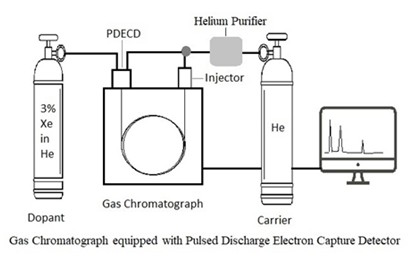
Determination of trihalomethanes using gas chromatograph equipped with pulsed discharge electron capture detector (PDECD)

Pages 297-305

https://doi.org/10.22034/AJGC/2020.3.6

Majid Hamouni Haghighat, Ali Mohammad Khah

Abstract Trihalomethanes (THMs) are the result of the reaction between chlorine and organic matter in the chlorination process of water. Measurement of this compound in water is necessary due to the possible risks to human health. In this study, direct aqueous injection (DAI) using a gas chromatograph equipped with a pulsed discharge electron capture detector (PDECD) was used to analyze the THMs. The results showed that there is a significant linear relationship between concentration and peak area up to a concentration of 300 μg/L for THMs (chloroform, bromodichloromethane, dibromochloromethane and, bromoform). The limit of detection (LOD) was obtained 4.2, 4.0, 4.3 and 5.3 μg/L. Without any preconcentration of samples, small quantities of LOD values indicate the proper sensitivity of the detector and the analysis method. As a result, instead of the common type of electron capture detector (using 63Ni), pulsed discharge electron capture detector can be used.

Sonolytic, sonocatalytic and sonophotocatalytic degradation of carboxymethyl cellulose (CMC): kinetic and mechanisms

Pages 306-316

https://doi.org/10.22034/AJGC/2020.3.7

Mojgan Sabzehzari, Sàdi Fattahimogadam

Abstract In this research, enzymatic degradation of carboxymethyl cellulose (CMC) with different concentration of substrate was studied using stable available parameters of Michaelis-Menton and calculated maximum reaction rate Vmax. We also used effective approaches such as ultrasonic, sonocatalytic and sonophotocatalytic irradiation in the presence of TiO2 nanoparticles as pretreatment. Degradation of the cellulose by means of ultrasound irradiation and its combination with heterogeneous (TiO2) was investigated. The emphasis was on evaluating theeffect of additives on degradation rate constants. Ultrasound irradiation (24 kHz) was provided by a sonicator, while an ultraviolet source of 16 W was used for UV irradiation. The extent of sonolytic degradation increased when ultrasound power (in the range 1560 W) increased, and the presence of TiO2 did not have significant effect on degradation. We should also note that TiO2 sonophotocatalysis led to complete cellulose degradation in 120 min with increasing the catalyst loading. TiO2 sonophotocatalysis was always faster than the respective individual processes due to the enhanced formation of reactive radicals as well as the possible ultrasound-induced increase of the active surface area of the catalyst. Their efficacy on enhancement of reactivity was discussed based on the kinetic parameters including, Michaelis constant Km, maximum reaction rate Vmax and initial reaction rate, correlating with ultrasonic conditions. Also, values of Km and Vmax were calculated in the absence and presence of ultrasonic and sonophoto waves.

N1,N1,N2,N2-tetramethyl-N1,N2-bis(sulfo)ethane-1,2-diaminium trifluoroacetate as an efficacious and dual-functional catalyst for the solvent-free preparation of pyrido[2,3-d:6,5-d′]dipyrimidines

Pages 317-326

https://doi.org/10.22034/AJGC/2020.3.8

Jaleh Atashrooz, Abdolkarim Zare

Abstract Ionic liquid N1,N1,N2,N2-tetramethyl-N1,N2-bis(sulfo)ethane-1,2-diaminium trifluoroacetate ([TMBSED][TFA]2) was utilized as an efficacious and dual-functional catalyst for the one-pot multi-component reaction of arylaldehydes, 2-thiobarbituric acid and ammonium acetate under the solvent-free conditions to afford pyrido[2,3-d:6,5-d′]dipyrimidine derivatives. Dual-functionality of [TMBSED][TFA]2 (having acidic and basic groups) caused that the products were obtained in high yields and short reaction times. Moreover, a logical mechanism based on dual-functionality of the catalyst was proposed.

A green method for separation of betaine from beet molasses based on cloud point extraction methodology using polyethylene glycol as a food grade surfactant

Pages 327-339

https://doi.org/10.22034/AJGC/2020.3.9

Mozhgan Mohammadzadeh, Ali Reza Zarei, Masoud Honarvar, Masoud Mashhadi Akbar Boojar, Hossein Bakhoda

Abstract In this study, an experimentally efficient and green-scalable procedure was designed using a sustainable surfactant to extract betaine from the beet waste (molasses) of sugar industry. This procedure was extended based upon the cloud point extraction (CPE) technique. An optimization framework was developed using the response surface methodology (RSM) to achieve an optimal value for the factors affecting the extraction efficiency of the experimental procedure. The main operational factors were surfactant concentrations, electrolyte concentration, pH, and the incubation temperature. Under the measured and optimal conditions, an extraction efficiency of as high as 88% was obtained for the betaine recovery. The polyethylene glycol (PEG) was used as a food grade surfactant that is a renewable substance approved by the U.S. food and drug administration (FDA) used in the food and drink industry. In the last step, the extracted betaine was freeze-dried at -56 °C for 16 h under 0.5 bar ambient pressure. The results revealed that, the final betaine powder product can be directly used as a supplement in livestock feed supply since PEG is an edible surfactant. Thus, the proposed experimental procedure for betaine extraction from molasses is regarded as a scalable, cost-effective, sustainable and eco-friendly approach.

Mechanistic Approaches and Current Trends in the Green Synthesis of Cobalt Oxide Nanoparticles and their Applications

Pages 340-354

https://doi.org/10.22034/AJGC/2020.3.10

Naimat Ullah, Rotaba Ansir, Wali Muhammad, Sadaf Jabeen

Abstract Nowadays nanotechnology is a buzzword in scientific area with diverse number of applications. The advancement in the eco-friendly and reliable systems for the development of nanoparticles are a crucial key to the discipline of nanotechnology. Nanoparticles have been incessantly evaluated and utilized in numerous industrial applications. Specifically, the rule of cobalt oxide nanoparticles has received an incredible interest due to its, UV filters properties and photochemical, antifungal, high catalyst, and antimicrobial activities. In chemical and physical techniques High rate of harmful chemicals are used for the synthesis of nanomaterials. To overcome this issue various clean and green methods are adopted which use plants, organisms and microscopic organisms for the synthesis of nanoparticles. This paper reviews different green synthesis techniques used for synthesis of cobalt oxide NPs and their applications. It was found that, the green route of synthesis is safe and eco-friendly. Additionally it is expected that the biomedical applications in this area will expand in different procedures including bio imaging, drug delivery, biosensors, and gene delivery. Also, cobalt oxide NPs can act about as sharp weapons against numerous drug resistant microorganisms and as a gifted substitute for antibiotics.